
The Prism Perspective: The Web You Weave 🕸️
Amy Bonaduce-Gardner | MAY 30, 2025

Hello friends,
Fascia. It's is basically the body's built-in cling wrap—keeping everything neatly bundled and preventing rogue muscles from going on an adventure.
Or think of it as the Wi-Fi signal for your body—constantly communicating and keeping everything connected, but if it gets jammed, suddenly things don’t work quite right.
Did you know that approximately 85% of your brain consists of fascia? To be classified as fascia, a substance must contain elastin, collagen, proteoglycan, and glycoproteins. It’s the slippery, slimy material that wraps around and links muscles, forms the cartilage of your nose, tendons, and ligaments, and suspends your intestines.
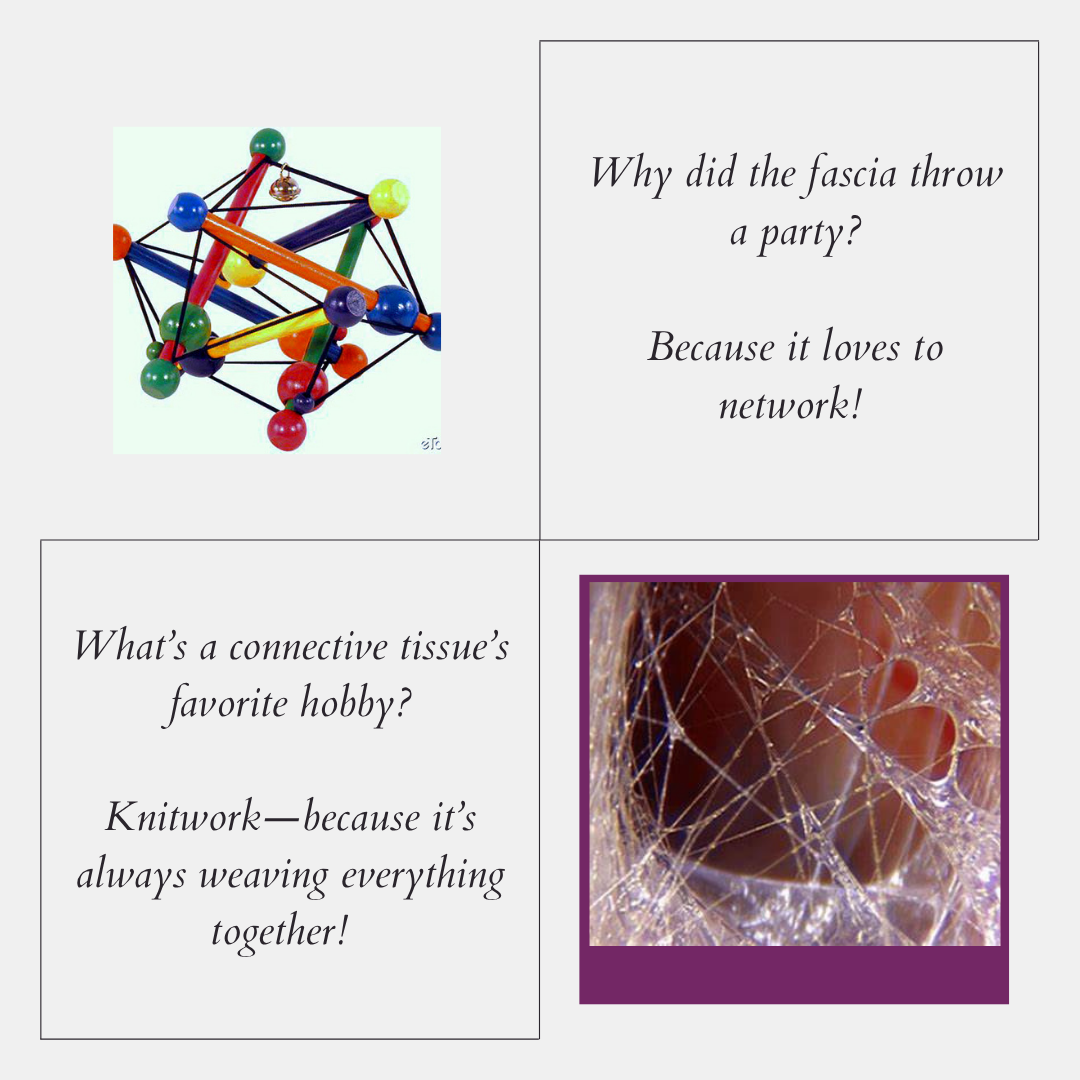
Fascia operates under a principle called tensegrity—a term coined by Buckminster Fuller, combining tension and integrity. It’s like a built-in scaffolding system, with bones suspended as compression elements that do not touch each other and fascia holding everything in place. This brilliant network keeps you upright and mobile, no matter what gravity tries to do.
You might have played with a tensegrity toy as a young tike:
Healthy fascia produces ground substance, a gel-like matrix that keeps it appropriately sticky and slippery and is often characterized as hydrated. Unhealthy or dehydrated fascia, however, is unrelated to the water you drink but rather to how your nervous system is choosing to use the water in your system. Instead, cortisol and adrenaline influence its liquidity, much like temperature shifts water between liquid, solid, and gas states. When adrenaline and cortisol levels are outside your Goldilocks zone, fascia becomes stiff, compacted, and rigid, much like an old rubber band. Think of it as your body’s way of responding to life—too much stress turns your fascia into a brittle mess.
Fascia also acts as a communication network, transmitting signals at the speed of sound. The electrical charge generated by healthy fascia is called piezoelectricity. When you step on a tack but don't feel it until after you've yanked your foot back - that's your fascia doing you a favor.
As a pressure medium, fascia distributes strain across the entire structure when under load. If the strain exceeds the body's tensegrity, it’s gonna show up where your body is weakest—the place of least resistance.
Additionally, healthy fascia vibrates much like the hum of a refrigerator, producing a signature unique to each of us. It’s your personal theme song, a humming signature that makes you a walking, vibrating masterpiece.
Plus, fascia slides! This lets you move in all directions, working hand-in-hand with your bones, blood vessels, and even your lymph system.
Tensegrity... It's fascia-nating.
For a somewhat long but very interesting look at real fascia: Strolling Under the Skin
Onwards, Amy
Amy Bonaduce-Gardner | MAY 30, 2025
Share this blog post



© 2026 Prism Movement Studio