
ABOUT OUR METHOD
A Different Way to Understand Your Body, Your Symptoms, and Your Nervous System
If you’re being introduced to this work for the first time, we know it can seem a little complicated at first. Here, we’re going to break it down.
First, and most importantly: your body is not broken.
It may simply be working from an outdated map.
At Prism Movement Studio, we use Holistic Biomechanics, body mapping, intentional movement, and nervous system coaching to help you understand the deeper patterns driving your pain, stress, movement limitations, or emotional responses—and give your nervous system the new information it needs to choose a different route.
Our work is rooted in The Fajardo Method of Holistic Biomechanics™, developed by Alicia Fajardo—a method we use to help update the internal map your nervous system relies on to move, protect, react, and respond.
Now, let’s break down what that means, how it works, and why it’s different from physical therapy, talk therapy, or all the “nervous system hacks” Instagram keeps feeding you that might help in the moment, but rarely create lasting change.
Core Methodology
What We’re Really Doing Here: Update the Map, Shift the Pattern
Your nervous system is constantly using an internal map to decide how your body should move, protect, react, and respond.
When that map is outdated, your body may keep repeating old patterns—bracing, guarding, tightening, shutting down, or reacting as if the past is still happening right now.
The Problem: You can’t keep operating from the same map that keeps leading you back to the same place if you want to create real change.
Whether you are working toward:
- Less physical pain
- Less daily stress and anxiety
- Less stuck in depression or trauma patterns
- Less defined by chronic illness or autoimmune symptoms
…you need a new map to get you to that new destination.
The Barrier
Why You Feel Stuck
This is why you can do the physical therapy, the talk therapy, and all the protocols you’ve been given — and still feel like you’re right where you started.
You may be trying to take a new route, but your internal GPS keeps rerouting you back to the same familiar pattern.
Your nervous system is holding the map and subconsciously driving your whole system to obey it.
The Process
We Go to the Source
Instead of trying to treat your symptoms in isolation, we work with the nervous system patterns underneath them.
We go to the source. And we help you rewrite that map.
Well, technically, we help you help your system rewrite the map—because your nervous system will always be at the wheel.
The Philosophy
A Different Approach to Regulation
This work is not about forcing your body to stretch harder, move better, or calm down on command. It’s not about trying to “regulate” your nervous system into submission—or avoid ever feeling “dysregulated.”
It’s about giving your nervous system new, accurate information so your body can begin rewriting old patterns that are no longer serving you and start moving through life with more ease, capacity, and adaptability.
What Is Holistic Biomechanics?
Holistic Biomechanics is a nervous system-based approach to movement, body awareness, and pattern repatterning.
You may also hear us describe this work as nervous system coaching, movement education, body mapping, joint biomechanics, or an alternative to traditional physical therapy.
But at the core, the work is about one thing:
Helping your brain and body understand each other more clearly.
We view the mind and body through the lens of the nervous system. That means we don’t look at pain, movement, stress, illness, or emotional patterns as separate problems living in separate boxes.
We look at the whole system.
Because your nervous system influences how you move, how you feel, how you respond to stress, how your body organizes itself, and how safe or unsafe life feels from the inside.
When your nervous system is working from old information, your body may keep running old patterns—even if those patterns are no longer helping you.
Holistic Biomechanics helps us identify those patterns and begin giving your nervous system new information to work with.
Core Paradigm
Another Way to Think About It: Your Nervous System Is Your Body’s Operating System
Your nervous system is constantly deciding how to respond to the world around you:
Am I safe?
Do I need to protect myself or brace?
Can I move freely, or do I need to fight, flee, freeze, or shut down?
Responsive State
When Information Is Current
When your nervous system responds appropriately to the present moment, your body has the capacity to move, rest, digest, focus, recover, and adapt.
Optimal System Output: Fluid movement, physiological ease, and adaptive stress recovery.
Protective State
When Information Is Outdated
Long-term physical, emotional, psychological, or mechanical stress can teach the system to stay locked in protective patterns. Over time, those patterns manifest on the outside as:
- Physical: Chronic pain, tension, guarding, recurring injuries, and movement limitations
- Systemic: Chronic stress, burnout, digestive issues, and chronic illness
- Emotional: Anxiety, depression, feeling stuck in fight-or-flight, or feeling disconnected from your body
This does not mean your body is broken. It means your system may be operating from old information. Our work helps update that information.
The Core Pillars of Our Method
Pillar A: Body Mapping (Updating the GPS)
Your brain holds a physical map of your body, with dedicated real estate for your joints, muscles, spine, and organs. But that map can become blurry or distorted through stress, injury, trauma, or lack of varied movement.
Think of body mapping like updating your phone’s GPS:
The Glitch: If your GPS has outdated road data, it keeps sending you through a closed intersection. Your nervous system does the same—sending continuous signals to brace, tighten, or avoid a movement based on old data.
The Update: Body mapping is the conscious process of bringing clear, current attention to specific areas of the body. When the brain gets better information, it updates the map, and the body automatically organizes itself differently.
Pillar B: Why Movement Matters
You cannot think your way out of patterns your body is still physically running. Movement is the primary language of the nervous system.
Every time you move, your brain receives sensory input from your joints, muscles, fascia, and skin.
Body mapping updates the map.
Movement lets your system test the new route.
Together, the mind and body in motion break the pattern loop.
Slow, simple movement gives your nervous system a chance to notice what’s actually happening now, instead of automatically repeating a past survival strategy.
The Goal Isn’t Regulation. It’s Adaptability.
A lot of nervous system work focuses on “regulation.” But at Prism, we don’t believe your nervous system needs to be regulated because it’s broken or doing something wrong.
Your nervous system is always trying to protect you. If it perceives a threat—whether real, remembered, physical, emotional, or environmental—it responds.
Those responses are intelligent adaptations, not mistakes.
Therefore, the goal is never to force your body into a state of forced calm.
The goal is adaptability.
Paradigm Shift
Moving Beyond Forced Regulation
The Wrong Goal
Forced Regulation
✕
Forcing the body to calm down on command
✕
Treating protective states as "mistakes" or bugs
✕
Trying to stay calm all the time
The True Goal
Adaptability
→
Responding appropriately to the actual present moment
→
Honoring states as intelligent adaptations
→
Having the capacity to cycle naturally between action and rest
Sometimes your body needs energy, alertness, and action. Sometimes it needs rest, repair, and recovery. The goal is not to be calm all the time.
The goal is for your nervous system to have enough accurate information and capacity to choose the response that fits the moment.
How Protective Patterns Get Stored in the Body
Your autonomic nervous system manages automatic functions like digestion, heart rate, and stress responses through two primary branches:
Sympathetic: Action, protection, fight-or-flight, alertness, and mobilization.
Parasympathetic: Rest, digestion, repair, recovery, and settling.
Neither branch is inherently "good" or "bad"—both are entirely necessary. The issue arises when your system gets stuck in one pattern and loses its fluid ability to shift.
When a familiar movement or position—like lifting your arm, turning your head, or sitting at your desk—has become linked with a protective sympathetic pattern, your system may move into that state automatically, almost like a habit you don’t have to think about.
Through body mapping and intentional movement, we introduce new sensory information so the motor cortex has more accurate data to work with—and can begin sending out more adaptable motor patterns.
Core Philosophy
What Makes This Different?
A whole-system approach that moves beyond temporary fixes to help you create lasting change at the source.
Whole-System Mapping
We don’t chase isolated symptoms.
Most approaches focus exclusively on the localized spot that hurts (the knee, the jaw, the anxiety). We look at the underlying systemic nervous system patterns shaping how your entire body organizes itself.
Intelligent Protection
We don’t treat your body like a machine to fix.
Pain, tension, and guarding are signs your system is trying to protect you. Our work is not about overriding that protection; it's about giving the body enough new data so it realizes it no longer needs to protect you in that old way.
Integrated Care
We bring the body and brain together.
Physical therapy often focuses strictly on mechanics. Talk therapy often focuses strictly on the mind. Prism works directly in the relationship between them.
Lasting Autonomy
We help you become the expert of your own system.
Our goal is not lifelong practitioner dependence. We teach you how your body works, building lasting autonomy, self-trust, and confidence.

What This Can Feel Like
Everyone’s journey is distinct, but clients regularly report both subtle and profound shifts as their system integrates new information:
Physical Changes: Less guarded muscles, smoother and more coordinated movement, easier breathing, and a reduction in chronic physical bracing or tension.
Internal Changes: A calmer, more settled baseline, feeling distinctly grounded, and experiencing increased emotional steadiness.
Cognitive Shifts: Becoming consciously aware of patterns you never noticed before, moving from a place of reacting to life to consciously responding to it.
Sometimes the shifts are physical. Sometimes they are emotional. Sometimes they are hard to explain—but your body knows something is different.
The goal is not just to feel better for one session. The goal is to help your nervous system build new information over time, so ease, capacity, adaptability, and resilience can become more natural—and so old patterns feel less like something to fear and more like something your system can learn to move through differently.
Client Compatibility
Who This Work Is For
This methodology offers profound support for individuals navigating four distinct paths. Click a category below to explore the struggles and everyday goals we address.
The Struggle:
Chronic pain, joint injuries, restricted mobility, or structural dysfunctions (neck, back, knee, or tailbone issues) that traditional PT hasn't solved.
The Everyday Goals:
Walking stairs without fear, avoiding surgery, or getting down on the floor with your kids or grandkids.
The Struggle:
Autoimmune challenges, cancer recovery, pelvic floor dysfunction, balance issues, or "unidentifiable" systemic fatigue.
The Everyday Goals:
Building enough internal safety to move out of constant survival mode and help the body recover.
The Struggle:
High-level professionals facing intense work burnout, chronic stress, dissociation, anxiety, depression, or stored trauma/cPTSD patterns that talk therapy hasn't reached.
The Everyday Goals:
Sitting at your desk without pain, moving away from old survival patterns, and getting through your day without feeling constantly stressed.
The Struggle:
Athletes, dancers, and physical performers looking for greater coordination, efficiency, range, and adaptability.
The Everyday Goals:
Optimizing your body’s capabilities and building a smarter relationship with your system without forcing it to work harder.
Whether your goal is to walk with friends, return to sport, or simply live without the shadow of pain—this work helps you understand what your body has been trying to tell you, allowing you to reclaim your physical agency and find true systemic peace.
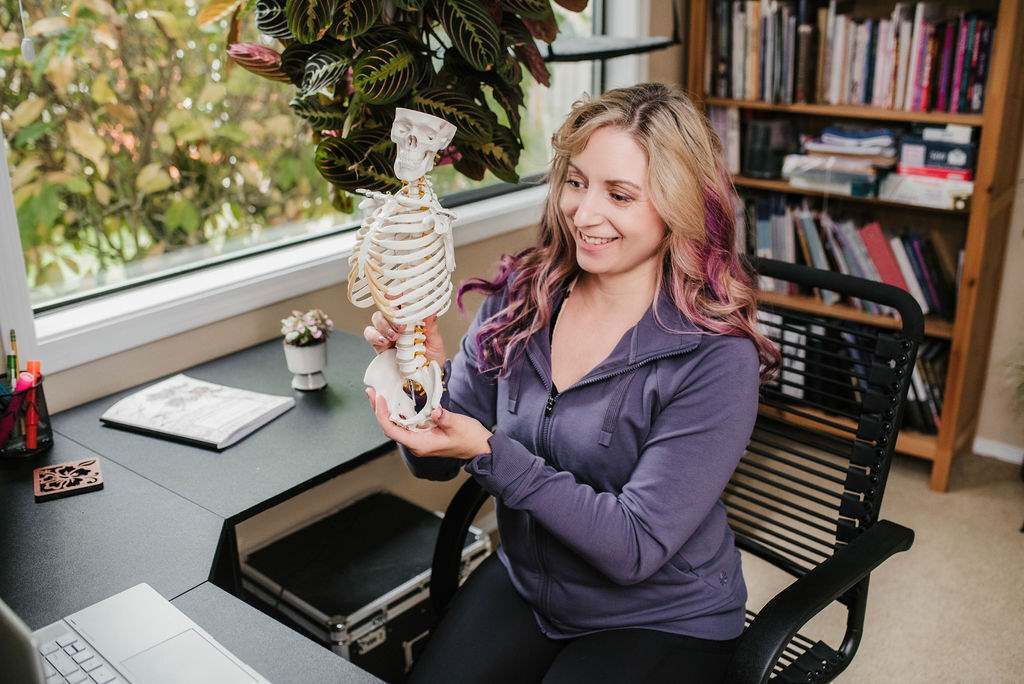
What Happens in a Session or Class?
Every Prism experience is an educational environment designed to build awareness through mapping and movement. Depending on your format, you will:
Focus on a specific region of the body and discover how it links to your larger system.
Use gentle movement, targeted compression, or awareness exercises to track bodily feedback in real time.
Identify the underlying patterns contributing to your pain, tension, or limitations.
Private 1:1 Sessions are highly customized, deeply analyzing your specific structural history, symptoms, and long-term recovery goals.
Group Classes & Membership are designed for consistent, sustainable practice over time—continually feeding your nervous system the fresh data it needs to build lasting adaptability.
Ready to Experience the Method?
Whether you begin with the course, the membership, a live class, or private 1:1 support, every path is designed to help you understand what your body has been trying to tell you—so you can create real change at the source.
Curious what body mapping actually feels like? Get instant access to a free 55-minute Prism Movement Studio class and experience how one small shift can create a ripple through your whole system.
Got Questions?
Frequently Asked Questions
Everything you need to know about our approach, methodology, and how to choose the right path for your system.
No. While this work may support pain, movement, and physical function, it is not traditional physical therapy.
Physical therapy often focuses on strengthening, stretching, rehabilitating, or treating a specific area of the body. Prism looks at the whole system—including the nervous system patterns that may be driving pain, movement limitations, stress, or dysfunction.
No. This is not talk therapy, psychotherapy, or mental health treatment.
Because the body and nervous system are connected, emotional patterns, stress responses, trauma patterns, anxiety, or depression may come up through the work. When they do, we support you through body mapping, movement, awareness, nervous system education, and coaching—not traditional psychotherapy.
Our coaching helps you notice what is happening in your body, understand the patterns that may be showing up, and stay connected to your experience as your system gathers new information.
Coaching is not therapy, and Prism Movement Studio does not diagnose or treat mental health conditions.
Not exactly. This work may feel gentle, mindful, or body-aware, but it is not yoga and it is not simply somatic movement.
The focus is on body mapping, nervous system patterning, joint function, and helping the brain receive new information through movement.
You do not need to be athletic, flexible, or experienced in movement to do this work.
This is not about performance. It is about awareness, information, and helping your nervous system understand your body more clearly.
Many Prism clients come to this work after exhausting many other approaches.
If you have tried stretching, strengthening, physical therapy, yoga, massage, therapy, mindset work, or nervous system tools and still feel stuck, it may be because the deeper system driving the symptoms has not been addressed.
Everyone is different. Some people notice changes after one session or class. Others experience shifts more gradually as their nervous system builds new information over time.
The goal is not a quick fix. The goal is lasting change through consistent practice, nervous system adaptability, and a deeper understanding of the patterns your body has been running.
That depends on your needs, symptoms, and desired level of support.
If you want to explore the method on your own, the course or membership may be a good place to begin. If you want personalized guidance for your specific body, symptoms, history, or goals, 1:1 support may be the best starting point.
If you’re not sure, a New Client Consult can help you choose the right path.